Is Confidence the Same as Excellence?
Confidence vs. Excellence: The Artistic Conundrum
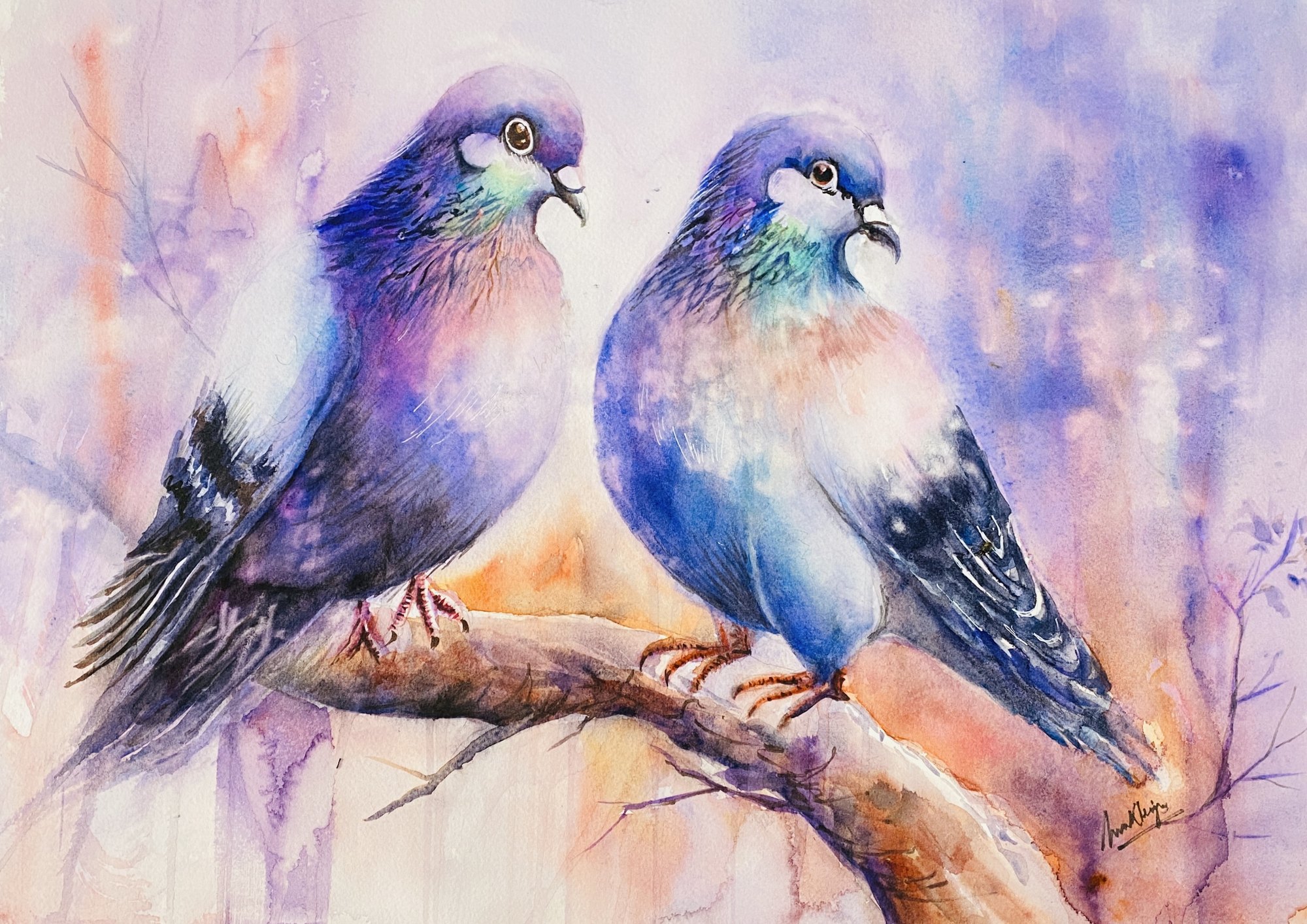
No. You see, feeling confident doesn't equate to achieving excellence. Confidence is a feeling about where you stand; excellence is a direction you keep walking.
Dear aspiring artists, let's dive into a fundamental aspect of our creative journey today – the fine line between confidence and excellence.
The question students ask
Many times, I've had students ask, "Can we paint something different as we have now become confident about subjects, like bird or flower?" It's a valid question, but therein lies a profound challenge.
It is valid because the feeling behind it is real. After enough birds, the hand stops hesitating over the first stroke. The shapes arrive more easily, and the fear that sat on the shoulder at the beginning has gone quiet. That quiet is earned, and it is worth something.
But look at what the question assumes: that a subject is a room you can finish and walk out of. That once the bird no longer frightens you, the bird has nothing left to teach.
Confidence answers one question: can I do this? Excellence keeps asking another: how well — and how much better? The first question has an end. The second does not.
A limit you never reach
Remember back in high school when we studied limits in calculus? It's a bit like that. Excellence isn't a fixed point; it's a function of your effort that approaches closer to one as your practice and dedication tend towards infinity.
Picture the curve. At the start it climbs steeply — every week of practice shows, every painting is visibly better than the last. Then it bends. The gains grow smaller and subtler, harder to see from outside. The curve keeps rising, but it never touches the line it is rising towards.
Confidence tends to arrive exactly at the bend. The steep part is over, the progress no longer shouts, and it is tempting to read the flattening as arrival. It is not arrival. It is the part of the curve where the real refinements live — the softer edge, the cleaner wash, the dark placed once and left alone — and only the person who keeps going will ever see them.
There is an odd comfort in the mathematics. A function that approaches one and never reaches it has not failed. That is simply its nature. Nobody reaches one. What matters is that the curve keeps climbing.
My grandmother's question
On such occasions, I love to share a story with my students!
Let's journey back to a time when life was simpler, and our brushes painted stories of youthful dreams – a time when we consciously considered the balance between confidence and excellence.
I fondly recall the days when my grandma spun the enchanting tales of Mahabharata, and my heart held a special place for Arjuna. She once asked me to ponder upon my preference among Ekalavya, Arjuna, and Karna and explain why. Without hesitation, I chose "Arjuna."
Her gentle wisdom led me on a path of reflection. My Grandma had smiled and asked me to spend the next few days thinking about what were the positive attributes in each of them and what were the negatives.
It is a quieter question than it looks. A preference is easy to state and hard to explain. Explaining it means looking underneath your own admiration to find out what, exactly, you are admiring.
Three archers
Three archers, and each one is a different answer to the question of why we learn a skill at all.
Ekalavya, a Nishada prince, came to Drona asking to be taught, and was turned away. So he went into the forest, shaped an image of Drona out of clay, and practised before it until his archery was extraordinary. When Drona found him, he asked for his teacher's fee: the thumb of Ekalavya's right hand. Ekalavya gave it without hesitation. His is the story of devotion without a school — and a wound the epic never quite closes.
Karna, too, was a formidable archer, yet the purpose behind his skill seemed different – to "become the best Archer in the world" rather than to simply "be an excellent archer." The epic gives him every reason. Raised by a charioteer, he walked into the tournament where Drona's pupils displayed their skill, matched Arjuna feat for feat, and challenged him to single combat — and was asked for his lineage instead of his aim. Duryodhana made him king of Anga on the spot, and from that day the measure of Karna's archery was Arjuna. When the measure of your skill is another person, that person quietly becomes the target.
And Arjuna. The epic tells of the day Drona set an artificial bird on a treetop and asked each prince, bow drawn, what he saw. The others saw the tree, the branches, their brothers, their teacher. Arjuna said he saw only the bird — and, asked again, only its head. It tells, too, of a night when the wind blew out the lamp while Arjuna was eating, and his hand still found his mouth in the dark. From that, he understood what practice could teach the hands, and began to practise with his bow at night.
You see, Arjuna's unwavering pursuit of excellence had quietly captured my heart.
The epic does not let even Arjuna stay simple. It was his dismay at being surpassed that took Drona into the forest to ask for Ekalavya's thumb. The wish to be the best can surface in the most devoted heart — which is exactly why the line has to be watched, and why it is so fine.
The fine line
The pursuit of excellence, I realized, teaches us humility, drawing a fine line between confidence and overconfidence. Any other reasons for acquiring skills or knowledge often blurs the fine line between confidence and over confidence.
Here is one way to see why. If your aim is to be the best, the aim can be completed — or taken from you by someone better. Either way, it ends. If your aim is to be excellent, there is always a next edge, a next wash, a next bird, and so you remain a student. Humility is simply what it feels like to stand in front of a limit you know you will never reach, and to keep walking towards it anyway.
None of this means a painter must paint the same bird forever. New subjects wake new problems, and variety has its place. But before leaving a subject because it no longer frightens you, it is worth asking a harder question than am I confident? Ask instead: what has the bird not yet taught me? Look again at the edge where the wing meets the air, at the lights, at whether the petals of the flower were painted once or worried into place.
The masterpiece that's you
The path we tread may have seemed mundane, the journey perhaps wearisome, but here's the cherished secret: it's in the joy of creation itself, not just the destination, where the magic resides.
This is the second gift of the limit. If excellence were a destination, every painting before it would be a waiting room. Because it is a direction, every painting is already the thing itself — one more point on the curve, still climbing.
As artists, we don't merely paint canvases; we weave the threads of our life's tapestry. The most genuine subject in our art is us, and every stroke etches a chapter of our journey, molding us into our true selves.
So, let's embrace the process, for it's not solely about the final masterpiece; it's about the masterpiece that's you.
The paintings →
My philosophy of painting →
The Studio Does Not Create the Artist →
Questions I Am Asked
Is confidence the same as excellence in art?
No. You see, feeling confident doesn't equate to achieving excellence. Excellence isn't a fixed point; it's a function of your effort that approaches closer to one as your practice and dedication tend towards infinity.
Should I move on to a new subject once I feel confident painting it?
Many times, I've had students ask, "Can we paint something different as we have now become confident about subjects, like bird or flower?" It's a valid question, but therein lies a profound challenge. You see, feeling confident doesn't equate to achieving excellence.
What is the difference between confidence and overconfidence for an artist?
The pursuit of excellence, I realized, teaches us humility, drawing a fine line between confidence and overconfidence. Any other reasons for acquiring skills or knowledge often blurs the fine line between confidence and over confidence.
Why does the process matter more than the finished painting?
The path we tread may have seemed mundane, the journey perhaps wearisome, but here's the cherished secret: it's in the joy of creation itself, not just the destination, where the magic resides. The most genuine subject in our art is us, and every stroke etches a chapter of our journey, molding us into our true selves.