When the Coin Grew Wings
On probability, agency, and the moment a model loses the world
There was a coin on the table in front of me, and a teacher’s voice describing what it could become.
Heads. Tails. Nothing else.
I remember the stillness of that sentence more than I remember the lesson. A coin is tossed, it turns through the air, gravity claims it, and it declares itself on the table — obedient, finished, countable. Somewhere in that obedience my attention slipped out the window, the way it always did when a problem felt smaller than the room it was taught in. And I asked the question for which the lesson had left no place:
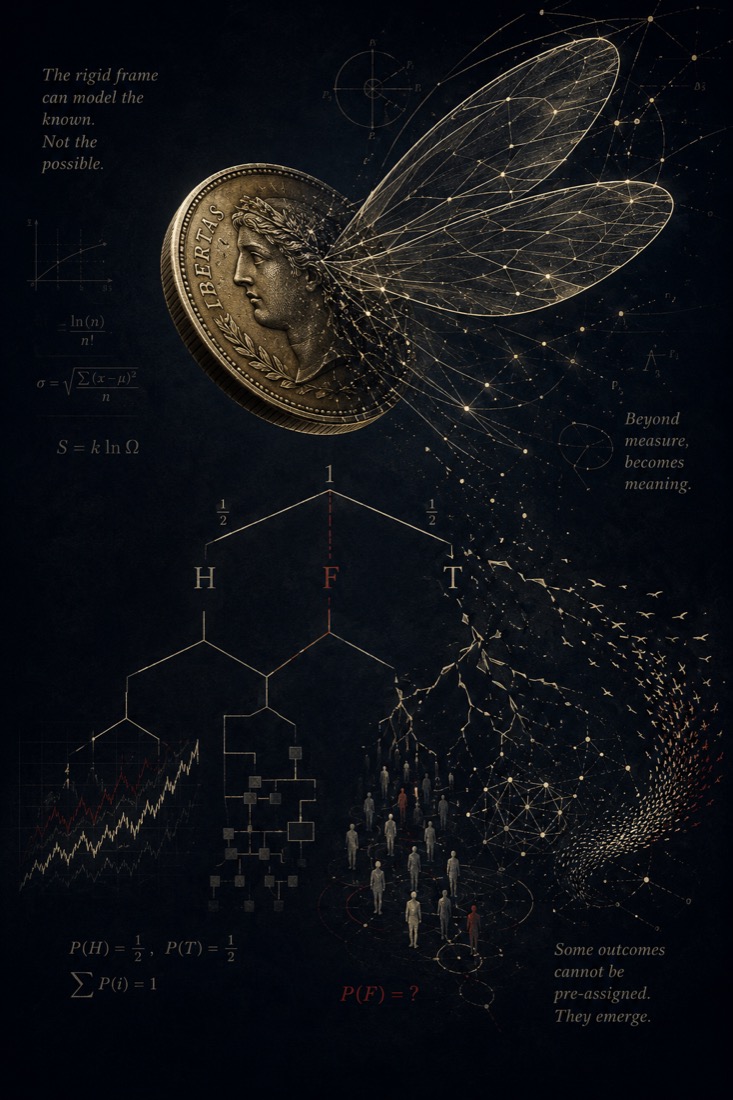
What if the coin grew wings? Not the wings we lend to ambition when we say someone’s dreams “took flight.” Actual wings — thin, translucent, rising out of the metal edge — and what if, halfway through the toss, it simply refused to land?
I did not know yet that I was asking a question about painting, about wealth, about every student I would ever teach. I only knew the coin had stopped obeying me, and that the disobedience felt more honest than the lesson.
The obedient universe
The elementary coin-toss model is a beautifully closed room. Give the coin two outcomes —
— and if it is fair, P(H) = P(T) = ½, so that P(H) + P(T) = 1. Everything that can happen within the model has already been accounted for. The coin has no intention. The table stays where it is. Tomorrow’s toss will answer to the same laws as today’s.
None of this is unreasonable. That is exactly why it goes unnoticed. A model rarely announces what it has left out — more often, it doesn’t announce what it has not yet conceived. There is a difference between hiding a door and not knowing a door was possible, and the second is so much harder to forgive yourself for, once you find it. The classical coin isn’t merely random — it is obediently random. It can surprise you with an outcome. It cannot surprise you with a new kind of outcome.
I have felt that same obedience in a wash of paint that behaves exactly as the tutorial promised. It is satisfying. It is also the least alive a painting can be.
The cage gets bigger, not gone
The easy fix is to enlarge the sample space:
Probability survives this without complaint —
— and the mathematics does not even blink. But nothing has actually escaped. We named the third outcome and gave it a seat before it arrived. The coin may fly, but only along a route we already drew.
The real trouble starts when flight stops being an event and becomes a revision — when the coin can hover, return, refuse, split itself in two, or persuade the coins beside it to rise as well, so that what counts as an outcome tomorrow depends on what happened today:
At that point the model is no longer predicting inside a stable world. The world is rewriting itself while the model is still working through its last calculation. That is the moment the coin has actually grown wings — not when it does something surprising, but when it does something we had no name for.
Six ways of not-knowing
We use one word, uncertainty, for at least six different kinds of ignorance, and it is worth walking through them the way I would walk a student through six kinds of edge in a wash — because they are not the same failure of knowledge, they are different architectures of it.
The coin that doesn’t remember. The tenth toss carries no wound from the ninth; heads doesn’t grow proud, tails doesn’t grow anxious. P(Xt+1 | X1, …, Xt) = P(Xt+1). This is uncertainty inside a fixed world — the map is stable, only our position on it unknown.
The coin in the wind. The sample space stays { H, T }, but the probabilities drift as a draft enters the room. Some of what looks like randomness is really a variable we haven’t learned to measure yet. I have called a bloom “unpredictable” more than once when the truth was that I hadn’t noticed the paper was slightly damp on one side.
The coin that leaves. It flies out the open window mid-toss. This is structural rupture — not a rare outcome inside the old sample space, but a refusal of the sample space itself. An employee who resigns from the role you were forecasting. A student who quits the technique you were about to correct. The coin doesn’t answer the question. It criticizes it.
The coin that remembers. It comes back, but changed — each toss modifying the wings that grow next time, so P(Xt+1 | history) ≠ P(Xt+1). This is where models of people quietly fail: a person who has been praised for one kind of brushstroke will keep offering that stroke, not because it is still the honest one, but because the last toss taught them what gets rewarded. Repetition doesn’t reproduce the same experiment. Sometimes it produces a slightly different participant.
The coins that watch each other. One winged coin is a curiosity. A thousand, watching and imitating one another, become weather — P(Fi | Fj) ≠ P(Fi). Fear moves through a room this way. So does courage, so does an entire generation of painters deciding, almost without discussion, that a certain form is worth attempting again.
The coin that studies the hand. The last and strangest turn: the coin begins reading the person tossing it, learning when heads is wanted and supplying it. The observer has climbed inside the observed system. A forecast about people can start shaping the very future it claims to describe — the model enters the world, the world reads the model, and the model, discovering it has become part of its own experiment, has to begin again.
The cage that no one builds on purpose
Here is the harder question, and the one I keep returning to: we almost never see a coin fly. Is that because flight was never physically possible — or because nobody, in a thousand years of tossing coins, ever thought to imagine one that could?
A mathematical omission has no power over metal. An equation cannot clip a real wing; that would be superstition dressed as science. But once an omission enters a classroom, a family, a tradition, it stops being neutral. It starts governing the hands that would otherwise have built the wing.
A child is told what someone “like them” can become — and it took me embarrassingly long to notice the verb tucked inside that sentence. Become. Not do. Not serve. Not tend to. Oh, I thought, the first time I actually heard it. We never really asked the question we meant to ask. We asked the child what she would turn into. We did not ask what she would offer, standing where she landed.
A doctor may begin with the memory of a fever relieved and gradually learn to measure the profession through comfort. An artist may begin with an encounter with colour and gradually substitute recognition for revelation. A leader may enter public life to build a road and eventually become more invested in remaining the person authorised to build it. None of these transformations requires a moment of betrayal. That is what makes them difficult to detect. The original purpose is rarely rejected; it is merely displaced, one reasonable decision at a time — until the equation balances perfectly and nobody remembers what used to sit on the other side of the equals sign.
I used to think a forecast was a kind of prison — bars, a locked door, something with the decency to announce itself as a limit. It isn’t. A forecast is sandpaper. It never forbids anything. It only reports what has been observed, in the calm, defensible voice of a well-run study — students from this school rarely qualify, girls in this stream underperform, families from this address don’t usually apply — and every sentence may be statistically defensible within the data it inherited, which is exactly what makes it dangerous. Sandpaper is honest too. It doesn’t cut. It doesn’t strike. It simply passes over the same grain, gently, thousands of times, until the wood believes that curve was always its shape.
Walk into any old stone stairway and you will find a shallow groove worn into the centre of each step — cut by nobody, intended by nobody, made only by generations of feet each choosing, once, the path that felt very slightly easier than the raw stone beside it. No single footstep carved that groove. But by the thousandth foot, the groove has become the only visible path, and the raw stone on either side starts to look less like an option and more like a mistake waiting to happen. A probabilistic forecast begins doing this to a mind the moment it stops being a description and becomes a classroom’s expectation, an institution’s policy, or a child’s verdict. It doesn’t order a child away from mathematics, or a girl away from leadership, or a boy away from tenderness. It just makes one direction fractionally smoother, semester after semester, report card after report card, until the population’s choices start looking suspiciously like the very prophecy that was only ever supposed to be measuring their worn-down stairs.
This is the abrasion no one is charged for. It leaves no bruise you could photograph, no policy you could repeal in a single afternoon. It leaves only a faint, self-erasing evidence: an entire cohort of children who never attempted the thing the forecast said they wouldn’t, standing as calm, silent proof that the forecast was right all along.
A student learns, without being told directly, which questions are safe to ask in a critique. An artist discovers, slowly and by inference, which subjects are considered serious and which are considered decorative. None of this is written down as law. It doesn’t need to be. If the surrounding world keeps assigning some possibility F a perceived likelihood that drifts toward zero —
— a person will eventually stop investing in it. Not because the underlying capacity necessarily diminished, but because belief altered the conditions under which that capacity could become visible:
The original low expectation, having quietly starved its own counter-evidence, gets to call itself confirmed:
I have watched a student repaint the same petal nine times. On the ninth, before I could stop myself, I said better — because the ninth version matched the reference exactly, and the eighth, the one where her hand had shaken and the pigment had bled slightly past the line, had matched nothing but her. I did not understand, until she had already packed her brushes and gone, what I had just taught her. Not technique. Trust. I had told her, in one careless syllable, which of her own marks deserved to survive.
That is the part I did not want to write. It is easier to describe the child, the doctor, the politician, and stay standing outside the equation, pointing in. It is harder to trace where the habit actually came from. In my own earliest days at the easel, I was taught to stay close to the reference — a kindness, I was told, meant to spare me the struggles my own mentor had already suffered and solved on my behalf. And when I began teaching in turn, I passed the same kindness forward without questioning it. I held my own idea of beauty, my own sense of artistic grammar, and asked my students to abide by it a little too faithfully, correcting them steadily back toward what I had already decided was right. I called it finesse. It was, more honestly, the pursuit of perfection dressed in finesse’s clothes — and it moved every student I loved a fraction of an inch away from the radical, unglamorous liberty of simply exploring. I do not know how many times, in how many studios before mine, someone did the same, each of them certain they were only teaching accuracy. I know only that I have done it too. Some nights I wish I had said wait instead — wait, tell me what you saw before the ninth version, before you decided the eighth one was a mistake and not a discovery.
The reverse is just as real, and just as unremarkable in its mechanism. A teacher notices a capacity a student hasn’t yet named for herself. A mentor lets an unfashionable question stand in the room instead of correcting it away. Nothing mystical happens. Belief doesn’t manufacture skill from nothing — it changes what gets attempted, what gets practiced long enough to fail productively, what survives the first clumsy version. A wing doesn’t need to be cut if the creature can simply be persuaded, early and gently, that flying was never on offer. I have been both hands. The one that persuaded, and the one that cut. I am still not always certain, in the moment, which one is doing the holding.
The coin that was flying the whole time
And then the deeper reversal, the one that undid my first, careless assumption: I had pictured “coin” as an inert disc, because that is the sample space a probability lesson hands you by default. But say coin and mean money, and the wings were never hypothetical.
There is a smaller, stranger cousin of this coin that many of us encountered as children without noticing the lesson folded inside it: a small golden ball given wings so that capture would remain difficult and pursuit would dominate the game. Catching it ends the chase and may overturn the score. Money resembles that Snitch more often than we admit. We inherit a game organised around pursuit, then act astonished that briefly holding its golden object never quite feels like having won.
Money rarely rests for long. It appears to, briefly, in a palm or a purse, and we mistake that pause for its nature. Its nature reveals itself in motion — a wage divided among food and rent, savings surrendered to the emergency that had been waiting its turn. For someone standing close to necessity, a coin arrives already carrying its itinerary. Rent has claimed one wing before the coin is even counted. Medicine is waiting in the air around the other.
A boy chases a golden ball because catching it can overturn the game, and the whole stadium rises to watch him try. A woman, not so far from where he plays, chases a coin because without it her child’s fever may not end at all. Both are chasing something built to fly. Only one of them gets applause for the pursuit, and only one of them can afford to lose.
We imagine sufficiency as a fixed altitude the coin might finally land on — wealth W reaching some threshold S where the flying stops:
But S is not a constant. It moves with illness, with responsibility, with the future a person is trying to protect:
— and every time wealth approaches it, the horizon has a way of stepping back. This isn’t a claim that poverty is merely a state of mind; material deprivation is exactly as real as it feels, and no reframing replaces food or safety. But past that floor, sufficiency becomes partly a question of vantage — enough for what, compared to whom, for how long — and money’s real relationship to a life is less about what it buys than about what it makes possible without asking permission first. Formal possibility and practical possibility are not the same number. Wealth is one of the few instruments that can close that gap.
Money has wings because it leaves us. It gives us wings because it lets us leave. Both sentences are true in the same coin, at the same time, and the tension between them is not a flaw in the metaphor — it is the metaphor’s entire point.
Before the next toss
The coin on the original table probably never grew anything. The whole flight likely happened in the narrow gap between a teacher’s sentence and a student’s wandering attention — which is, I have come to think, exactly where most real questions are born.
But an imagined wing can still expose a real assumption. It showed me that uncertainty doesn’t only live inside the outcomes we’re waiting on. Sometimes it lives in the boundary that decided, quietly and long before we arrived, what was allowed to count as an outcome at all. It showed me that systems remember, imitate, and eventually study the hand that keeps tossing them. And it showed me that the most dangerous model is not always the visibly wrong one. It may be the locally accurate model whose success persuades us to mistake its boundaries for the boundaries of reality.
I still think, more often than I say out loud, about the girl and her ninth petal. I cannot undo the word I said to her. I can only try, in every room after that one, to ask wait before I ask better — to notice the eighth version before I correct it into the ninth, and to remember that every critique quietly influences which outcomes another person will dare to attempt.
So before the next toss, perhaps the question is no longer only:
Perhaps it is:
Whose hand clipped which wing — and was mine among them?
And has anyone looked beyond the table lately, to see whether the coin has already left?